A handover moves a live caller from the AI to a person on your team without hanging up and calling back. The agent says one short connecting line, the caller waits on hold music, Foan rings your colleague on a second leg, briefs them on what has happened so far, and then leaves the call. The two humans finish the conversation on their own.
Most of the value is in the details, so here is the whole sequence, including what happens when it fails.

What does the caller actually hear?
The caller experience is deliberately short and predictable.
- The agent speaks one connecting line. Something like "I am going to transfer you to a specialist who can help with this." That is all the caller gets, and it should be enough.
- The caller is moved into a conference with hold music. They are not left in silence, and they are not asked to press anything.
- Foan dials your human on a second leg while the caller waits.
- Your colleague hears a short AI briefing of the call so far, two or three sentences, before anyone is connected.
- Your colleague joins the conference and the caller hears a person.
- The AI leaves the moment the transfer is accepted.
That last point is the one people get wrong. The agent does not hover, listen in, or write notes over the top of the human conversation. Once the transfer is accepted, the AI is gone and the call belongs to the two people on it.
What does your colleague hear before they join?
A cold transfer drops a confused caller on a colleague who has to start from zero. That is worse than the missed call it replaced, because the caller has already explained the problem once.
Foan does a briefed transfer instead. When the second leg is answered, the person who picked up hears a short spoken summary of the conversation so far before they are joined to the caller. It is generated from the call that just happened, not from a template, and it is two or three sentences, not a recital of the transcript.
Practically, that means your colleague picks up already knowing who is on the line and what they want. The caller then does not have to repeat themselves, which is the single most common complaint about any transfer, human or automated.
What happens if nobody answers?
Dead air on hold music is the failure mode worth designing against, so it is handled explicitly.
The second leg rings for 30 seconds. If your colleague does not answer inside that window, or the line is busy, or the leg reaches an answering machine, the caller does not keep waiting. They hear an apology and the call ends. It is not a good outcome, but it is an honest one, and the caller is free to call back or leave the queue rather than holding for a person who is never going to arrive.
The reverse case is handled too. If the caller gets tired of the hold music and hangs up while your phone is still ringing, the outbound leg is cancelled. Your phone stops ringing and there is no orphan call sitting there.
Answering machine detection matters more than it sounds. If the number you nominate is a mobile that diverts to voicemail after a few rings, an unguarded transfer would deposit your caller into your colleague's voicemail greeting and then hang up on them. That does not happen here.
Handover is easier to understand with an agent in front of you, so create a free account and set it up on a test agent before you put it on a real line. Phone agents covers the call path it sits inside, and pricing explains the two legs you start paying for the moment the bridge connects.
Where is handover configured?
There is no dashboard screen for handover today. Do not go looking for a toggle on the agent page, because there is not one.
Four settings control the whole behaviour:
| Setting | What it does |
|---|---|
| Whether handover is on | Enables the behaviour for that agent |
| Target number | The number Foan dials for the second leg |
| Criteria | The plain description of when the agent should transfer |
| Acknowledgement line | What the caller hears just before the hold music |
All four are accepted over the public API, the foan CLI and the MCP server, or the Foan team can set them up on your agent for you. There is no separate rota, schedule or round robin setting: those four fields are the whole surface.
One related field does live in the dashboard. Open the agent, expand Call Messages, and you will find Escalation Message alongside the greeting, closing and voicemail messages. Its placeholder is "I'm going to transfer you to a specialist who can help with this." Keep that wording and your acknowledgement line consistent so the caller hears one voice rather than two different scripts depending on how the transfer was triggered.
How should you write the handover criteria?
The criteria field is a plain description, not a rule engine, so write it the way you would brief a new colleague on their first shift.
Describe the caller, not the topic. "The caller is upset and has asked twice for a person" is a usable trigger. "Billing" is not, because half of your billing calls are a question the agent can answer from your knowledge base.
Name the cases you never want transferred. Criteria that only say when to escalate tend to escalate constantly. Say what stays with the agent: opening hours, order status, directions, anything the agent already has the facts for.
Keep the list short. Three or four situations that genuinely need a person will behave better than a dozen overlapping ones. Remember that everything you write into an agent sits inside a combined instruction budget, capped at 4,000 characters across all of the instruction fields, with a warning at 3,000.
Include an explicit request. A caller who says "put me through to someone" should get a person. It is the clearest signal you will ever get, and an agent that argues with it will be described as a robot that would not let them speak to anyone.
What should the acknowledgement line say?
One sentence. Say that you are connecting them, and say to whom if you can be specific.
Good lines are short and concrete: "Let me put you through to our front desk now." "I am connecting you to someone on the service team." Both set an expectation the next 30 seconds can meet.
Avoid three things. Do not promise a named individual, because you are dialling a number and you do not know who picks it up. Do not apologise at length, because the caller now waits through an apology as well as hold music. Do not promise a wait time, because you cannot know it.
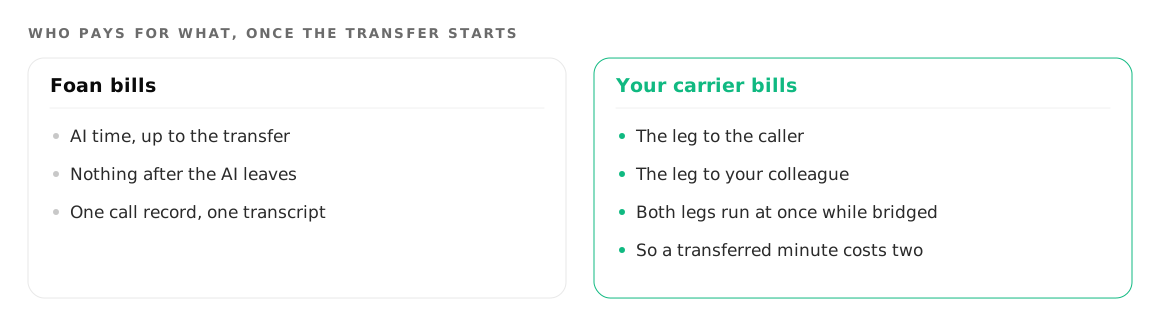
Who pays for what on a transferred call
Two meters run, and they measure different things.
Foan bills the AI time, from the start of the call to the moment the agent leaves. The part of the conversation between your colleague and the caller is not AI time and is not billed as such, however long it runs. Rates are set per organisation, and the pricing page has the published starting point.
Your telephony carrier bills both legs, the original inbound call and the outbound leg to your team, for as long as the two of them keep talking. A transfer therefore costs less AI time than the same call handled entirely by the agent, and more carrier time, because there are two legs up instead of one. Budget for it as telephony, not as AI.
Two worked examples are worth reading before you decide where the line sits: what must stay with a person on a restaurant line and the urgent cases a clinic agent should never try to handle.
When is a transfer the wrong answer?
Handover is not a substitute for an agent that knows its job. If a quarter of your calls end in a transfer, the fix is usually a better knowledge base or a tool that looks the answer up live, not a faster transfer.
It is also the wrong answer when nobody is there. Outside working hours the second leg just rings out and your caller gets an apology after 30 seconds of music. Where that is a risk, it is kinder to have the agent take a message and a callback time than to try the transfer and fail.
And it is the wrong answer for anything that is really a task. Booking an appointment, checking an order, or taking a payment reference is better handled by the agent calling your system directly than by fetching a person to type it in.
Where to go next
If you are still building the agent that will do the escalating, how to build an AI phone agent covers the identity, voice, knowledge and tools that decide how few calls ever need a person. For a worked example of where a transfer genuinely earns its place, AI appointment scheduling for clinics walks through the calls a front desk should always take itself.
For everything the agent does before it reaches for a human, see phone agents.
Try it on your own number
Build an agent, point a number at it and listen to the first call.