You do not need to port a number, buy a new one, or touch a SIP trunk to put an AI agent on your phone line. Set conditional call forwarding on the number you already publish, point it at a Foan agent's number, and every call your team does not pick up inside the ring window lands on the agent instead. Setup takes under a minute from the handset, and it is reversible in one dial code.
This is the fastest route to a live agent, and it is the one almost nobody documents. It also has real limits, which are covered further down.
Why porting is usually the wrong first step
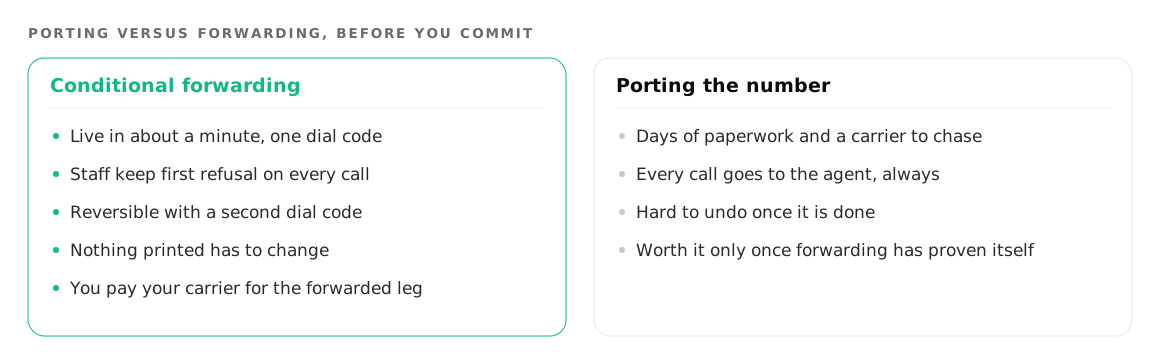
Porting moves ownership of a number to a new carrier. It takes days, it needs paperwork, and while it is in flight you are exposed: if anything goes wrong, the number your customers have saved stops working. That is an unreasonable risk to take for a pilot.
Buying a brand new number avoids the risk but creates a different problem. Nobody calls it. Your number is printed on menus, listed on Google, saved in a thousand phones, and pasted into chat threads. A new number reaches none of that traffic, so a test on it tells you nothing about how the agent copes with your real callers.
Forwarding sidesteps both. Your published number stays exactly where it is, in your name, with your carrier. All that changes is what happens to a call your team does not answer.

How conditional call forwarding works
Every GSM carrier supports four forwarding conditions, set from the handset with a dial code. The one that matters for an AI agent is forward on no answer: the phone rings for your staff first, and only if nobody picks up does the network divert the call.
The useful conditions:
- No answer. Staff get first refusal, the agent catches the overflow.
- Busy. Diverts only when the line is already engaged.
- Unreachable. Diverts when the phone is off or out of coverage.
- Always. Every call goes straight to the agent, staff never ring.
Most businesses want no answer, busy and unreachable set together. That gives you humans first, AI as the safety net, and nothing ever ringing out.
You need an agent number before a dial code does anything, so create a free account and get one attached first. Phone agents covers what answers on the other end, and pricing covers the Foan side of the cost, which is separate from what your carrier charges for the forwarded leg.
What are the exact dial codes?
These are standard GSM codes, dialled from the phone that owns the number you are forwarding. Replace the number after the second asterisk with your agent's number in full international format.
- Forward on no answer, the setup most businesses want: dial
**61*+91XXXXXXXXXX#and press call. - Forward when busy: dial
**67*+91XXXXXXXXXX#. - Forward when unreachable: dial
**62*+91XXXXXXXXXX#. - Forward always, for out of hours or a fully automated line: dial
**21*+91XXXXXXXXXX#. - Check what is currently set: dial
*#21#. - Cancel everything: dial
##002#.
The handset confirms each one with a network message within a second or two. These codes were tested on an Airtel connection in India on 18 September 2026. Jio does not accept the same codes reliably: on a Jio SIM, use Settings, then Call forwarding, and fill in the same destination number through the phone's own menu.
On iPhone the equivalent lives in Settings, Phone, Call Forwarding, but the iOS menu exposes only always-forward. For conditional forwarding on an iPhone, dial the codes.
What the agent sees on a forwarded call
The important question with any diversion is whose number arrives at the other end. If the agent only saw the forwarding SIM, every caller would look identical and nothing personalised would work.
It does not work that way. On the forwarded calls tested on 18 September 2026, the original caller's number was delivered to the agent. The agent could therefore recognise a returning caller, greet them by name, and pass the caller's number to any tool it called during the conversation without asking for it. Everything that depends on caller identity behaves exactly as it does on a number the agent owns outright.
What forwarding costs
There are two meters running on a forwarded call, and it is worth being clear about both before you switch it on.
Your carrier bills the forwarding leg to the SIM that forwarded it. To the network, that SIM placed an outgoing call to the agent's number, so it is charged at your normal outgoing rate for as long as the conversation lasts. On a plan with generous outgoing minutes this is close to free; on a pay as you go connection it is not nothing.
Foan bills the agent's time separately, per minute, at the rate set on your organisation. Our pricing page has the current published rates, and what an AI voice call costs per minute breaks down what actually drives the number.
When forwarding is the wrong answer
Forwarding is a bridge, not a destination. Move off it when any of the following is true.
You take more than one call at a time. A forwarded line generally carries a single call. Two simultaneous callers means the second one hears an engaged tone, which is worse than the missed call you were trying to fix. Busy restaurants at 8pm and clinics on Monday morning hit this quickly.
You are running outbound as well as inbound. Forwarding only moves calls in one direction. Outbound campaigns need a number the agent can dial from, which means a number on your own connected telephony account or one bought through Foan.
You need call recordings and analytics tied to one line. These work either way, but a number the agent owns gives you a single clean record of everything that happened on it, without the forwarding leg sitting in your carrier bill as a separate set of calls.
You want the agent to answer first, every time. Always-forward achieves this, but at that point you have effectively made the agent the line's owner and you may as well give it a number of its own.
When you outgrow forwarding, Numbers, then Buy Numbers in the dashboard lists numbers you can take on the spot. Indian numbers go through Foan's numbering partner and need a short KYC wizard: registration, PAN, Aadhaar through DigiLocker, GST if you are a business, then a final step. Outside India, connect your own Plivo account and buy in any country Plivo sells.
Turning it off
Cancel every forwarding rule on the SIM with ##002#. To remove only the no-answer rule, dial ##61#. Check what is still active with *#21#.
This is the part that makes forwarding a low-risk pilot. If the agent says something you do not like on a Tuesday afternoon, the fix is one dial code from the same phone, and your number is back to normal before the next call comes in.
Where to go next
Point forwarding at an agent that already knows your business. Build the agent first, give it your hours, menu or price list, and test it by calling your own number from a different phone: how to build an AI phone agent walks the whole thing end to end. If some of those calls need a person, handing the call to a human explains what the caller hears during a transfer.
For what the agent can do once it picks up, see phone agents.
Try it on your own number
Build an agent, point a number at it and listen to the first call.