An AI voice call is billed per minute of call time, at a rate set on your organisation and held in US dollars. Foan's published starting point is voice from $0.05 per minute, on the pricing page. What a given call actually costs depends on how long the conversation runs, how the seconds are rounded, and the telephony leg underneath, which is billed separately from the AI time.
That last point is where most cost surprises come from. The number on your Foan balance card is not the whole meter.
What are you actually paying for?
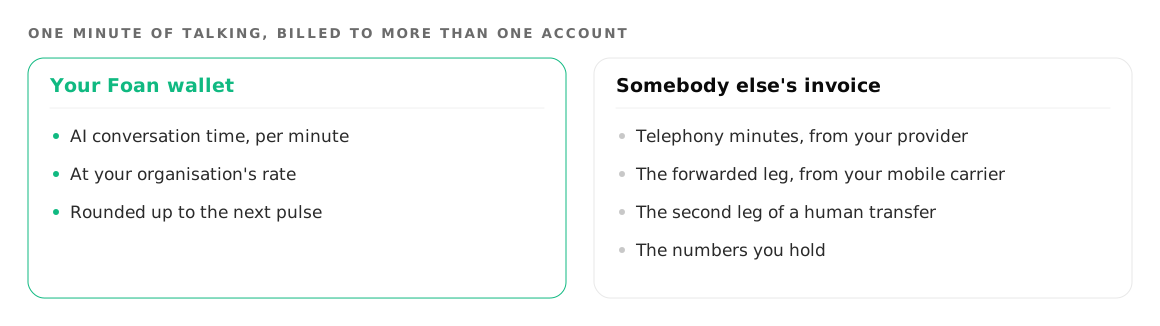
A call has more than one bill attached to it, and they do not all land in the same place. The table below separates them.
| Component | Who bills it | Where it shows up | What makes it grow |
|---|---|---|---|
| AI conversation time | Foan | Your prepaid wallet, per minute of call, at your organisation's rate | Longer conversations, rounding up to the next pulse |
| Telephony minutes | Your telephony provider, or Foan's numbering partner for Indian numbers | Your provider's invoice, or the number's own pricing | Call duration, destination country, mobile versus landline |
| The forwarded leg, if you forward a business line | Your mobile carrier | Your normal carrier bill, as an outgoing call | How long the forwarded conversation lasts |
| The second leg of a human transfer | Your telephony provider | Provider invoice, for as long as the human and the caller talk | Transfers that turn into long human conversations |
| Numbers you buy | Your telephony provider, or the number's listed price | Provider invoice | How many numbers you hold |
Nothing here is hidden, but the components sit in different accounts, so a finance team looking only at the Foan wallet will always under-count the true cost of a minute of talking.
Why a one minute call is not a sixtieth of an hour
Foan supports pulse billing, and it is the single most common reason a short call costs more than a reader expects. A pulse is the smallest block of time the platform will sell. A call is rounded up to the next whole pulse before the rate is applied.
On a 30 second pulse:
- A 10 second call bills as 30 seconds.
- A 31 second call bills as 60 seconds.
- A 61 second call bills as 90 seconds.
Pulse length is a setting on the organisation, not a universal rule, so check what yours is before you model anything. The behaviour to plan around is the direction of the rounding. It is always up, never down, and it is applied once per call, not once per minute.
The practical consequence is that call count matters as much as call length. Two hundred calls that each last eight seconds are not eight seconds of usage two hundred times over. Under a 30 second pulse they are a hundred minutes. If you are running high-volume outbound where a lot of numbers ring out or get rejected quickly, the rounding is not a rounding error. It is a line item. The setup choices that reduce that waste are covered in outbound calling campaigns.
How the wallet and the billing country work
Billing is prepaid. You top up a wallet, calls draw it down, and a top-up quotes the credit, the fees, the tax and the total before it creates the payment order. The minimum top-up is USD 50, and the checkout link a top-up generates is valid for 30 minutes, so do not request it and then walk away for an hour.
Your organisation has a billing country. That country decides both the currency you are charged in and the route your payment takes through our payment processor. Indian organisations go through one route, everyone else through another. The important detail is that the billing country is set once and cannot be changed after your first payment. Get it right before you top up, because unwinding it afterwards means a new organisation, not a settings change.
One thing that is not on your Foan bill today: recurring monthly rental on Indian numbers bought through Foan's numbering partner. Those numbers display a price, and that price is what the number costs, not a charge that repeats on your next invoice. That may change. Do not build a forecast that assumes it never will, and do not assume it is charged today either.
What makes a call expensive?
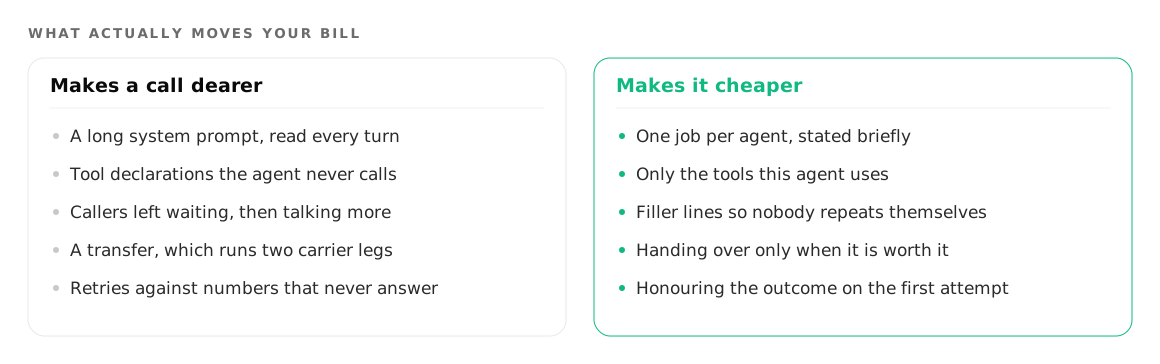
The billing mechanics are simple. The engineering that decides how many billed seconds a job consumes is where the real money is. Four things dominate.
How long the conversation runs
This is obvious and still the biggest lever. A booking that takes forty seconds costs less than the same booking taking two minutes, and most of the difference is not the caller. It is the agent asking for things it did not need, confirming things twice, or reading out a paragraph where a sentence would do.
Read your own transcripts and count how many turns it took to get the outcome. Most agents can lose a third of their turns without losing anything a caller cares about.
How long your instructions are
Every instruction field you write is sent to the model. Foan caps customer-authored instructions at 4,000 characters across all the instruction fields combined, with a warning at 3,000. That ceiling is there partly for quality, because a bloated prompt makes an agent slower to respond and more likely to wander, and partly because processing it is work on every single turn of every single call.
A tight 1,200 character prompt with the facts in a knowledge base beats a 3,900 character prompt that tries to hold everything in its head. It is also faster, and faster means fewer billed seconds.
How many tool round trips it makes, and how slow they are
Every time the agent calls one of your webhooks, the caller waits. If your order lookup takes four seconds, that is four seconds of billed call time on every call that checks an order, plus whatever the agent says to fill the gap. Two tool calls in one conversation and a slow endpoint behind each one can quietly add ten seconds to every call you handle.
The webhook timeout on a tool defaults to 10,000 milliseconds. That is a ceiling, not a target. Anything that regularly runs near it is costing you money on every call, and the fix is on your side of the wire: cache the common lookups, return the minimum the agent needs to speak a sentence, and keep the endpoint close to the region the call runs in.
Silence, hold time and dead air
Billed time is wall-clock time on the call. A caller who goes quiet to find their order number is being billed. A caller sitting in a conference with hold music while a human is dialled is being billed for the AI leg up to the point the AI leaves. A voicemail greeting the agent talks over is billed.
None of this is unfair, but it means your cost per useful outcome is not the same as your cost per minute. Track both.
What does a transfer to a human cost?
Transfers have two meters, and they run for different lengths of time.
Foan bills the AI time, from the start of the call to the moment the AI leaves. That moment is when the transfer is accepted, not when the caller finishes talking to your team. Everything after that is a human conversation and is not AI time.
Your telephony carrier bills both legs, the caller's and the one dialled out to your team, for as long as they are connected. A five minute human conversation after a forty second AI conversation is mostly a carrier cost, not a Foan cost. That is the right shape, and it means transfers are cheaper on the AI side than a long agent-only call, but it also means a high transfer rate does not make your phone bill go away. The mechanics of what the caller hears, and what happens if nobody picks up, are in handing the call to a human.
Published rates are a starting point and your own calls are the answer, so create a free account, run twenty real calls and read the per call figures. Pricing lists what is charged, phone agents explains what the minute buys, and for the two biggest swings see why a transfer runs two carrier legs and how long prompts slow a reply down.
How do you measure your own cost per minute?
Do not trust any table, including this one, over your own call history. The measurement is straightforward.
- Pick a window with real traffic in it, a full week rather than a good day.
- Export your call history for that window from the dashboard. It carries the per-call durations and outcomes.
- Take the total billed spend from your wallet for the same window and divide it by the number of calls, not by the number of minutes. Cost per call is the number that survives contact with pulse rounding. Cost per minute hides it.
- Split the calls by outcome. Answered calls, unanswered calls, busy lines and voicemails have very different durations, and if the short ones dominate your volume, rounding is your main cost driver rather than conversation length.
- Now split by agent and by campaign. One agent with a long prompt and a slow tool behind it can carry the whole average.
Repeat it after any prompt or tool change. A change that shortens the median conversation by fifteen seconds is worth more than any rate negotiation you are likely to win.
Where to go next
If you are about to run volume, read outbound calling campaigns before you load a list, because retry rules and call windows move your bill more than anything in the agent prompt does. If your calls end with a person, handing the call to a human explains exactly where the AI meter stops.
For what an agent can do while that meter is running, see phone agents.
Try it on your own number
Build an agent, point a number at it and listen to the first call.