
Foan is the narrower, India-first choice: one prompt page, bring your own Plivo account or buy an Indian number through us, plus an API, a CLI and a hosted MCP server. Vapi, Retell and Bolna publish broader platforms with bigger integration libraries. This post compares what each company states on its own pages, checked on 19 September 2026.
How we compared, and on what date
This post is written by Foan, about Foan and three competitors. That is a conflict of interest, so here is what we did.
Every statement about Vapi, Retell AI and Bolna comes from a page that company publishes itself, fetched on 19 September 2026 and listed in the sources block below. Where a platform does not publish something clearly, we write "not published" rather than guessing.
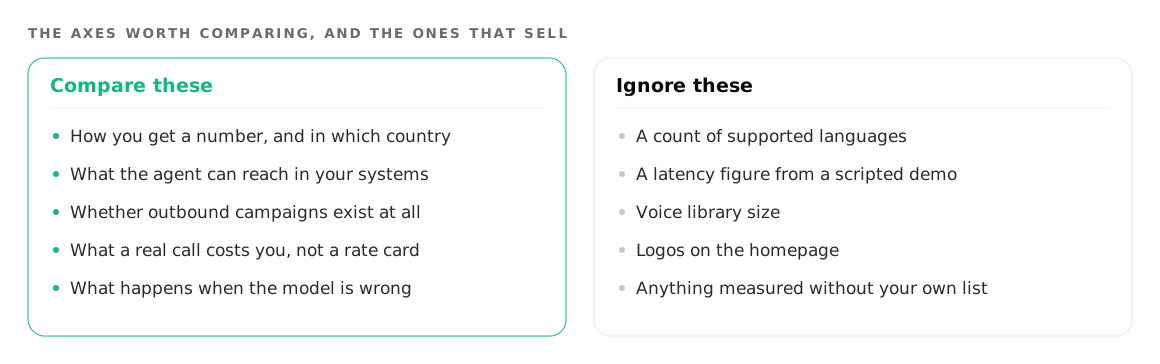
We did not run a benchmark. You will not find a latency figure, an accuracy score or an uptime claim about anyone here, including us. Platforms measure latency differently: some from end of speech, some from the last audio packet, some excluding the telephony leg. A number nobody measures the same way is not evidence. So this sticks to what you can verify by opening the same pages we did, and those pages change, so check the dates.
At a glance: how do the four compare?
| Foan | Vapi | Retell AI | Bolna | |
|---|---|---|---|---|
| Who the public pages address | India-first phone work, API-comfortable teams | Developers on an infrastructure platform | No-code dashboard users and developers | India-first, multilingual voice |
| How you build an agent | Prompt fields on one agent page | Dashboard with "no coding required", or code and SDKs | "Conversation Flow Agent" or "Single Prompt Agent" | Dashboard "Studio", API, or prompts |
| Visual node flow builder | No | Workflows documented as retired 18 Aug 2026, replaced by Squads | Yes, "Drag-and-drop, node-based flows" | Not published as a node graph |
| Telephony model | Own Plivo account, Exotel import, or Foan's India partner | Free Vapi number plus imported provider numbers | Managed number or "your own provider over SIP trunking" | Connect Plivo, Twilio or Exotel, or buy in dashboard |
| Indian numbers offered directly | Yes, with a five-step KYC wizard | Free numbers documented as "US area codes" | Managed numbers documented as "US or Canada" | Yes, "via Plivo or Vobiz" |
| How pricing is published | From $0.05 per minute, rate set per organisation | Platform fee plus itemised pass-through | Per minute range plus add-ons | Per minute in USD and INR, plus bundles |
| Hosted MCP server | Yes | Published for its documentation | Yes | Yes |
| Command line tool | Yes | Yes | Not published on pages we checked | Not published on pages we checked |
Building an agent: prompt, flow, or code?
A Foan voice agent is one page of structured prompt fields: Agent Identity, Agent Personality, a free text "Language and accent" box, Agent Task and Pronunciation. Below sit collapsible sections for Call Messages (greeting, closing, escalation and voicemail lines) and Voice Selection, with a speaking speed control. There is no canvas and no graph. The whole instruction set is capped at 4,000 characters combined, with a warning at 3,000.
That cap is a design position. Short instructions are easier to debug and you can read the whole agent in one screen, but Foan cannot hold a fifteen page scripted flow.
Vapi's quickstart documents two routes: building "in 5 minutes using our dashboard" with "no coding required", and building "with code and SDKs". Its Workflows product is documented as retired on 18 August 2026, replaced by Squads, which Vapi describes as letting you "break complex workflows into multiple specialized assistants that hand off to each other during a conversation".
Retell's introduction lists a "Conversation Flow Agent" with "Drag-and-drop, node-based flows for structured, high-stakes calls" alongside a "Single Prompt Agent" where you "Define your whole agent with one prompt". Bolna's docs describe a Studio going "from a brief description to a production-grade, call-ready voice AI agent in 5 to 8 minutes", plus agent creation over its API.
If you want a visual builder today, Retell publishes one and Foan does not. A walkthrough of the prompt-field approach is in how to build an AI phone agent.
Languages and Indian accents: what is actually supported?
Foan supports English plus 22 Indian languages, with dozens more international languages available. We do not publish a single total, because routing differs by language and one number would mislead.
The control is one free text field, "Language and accent", capped at 200 characters. You write something like "Singaporean English" or "speaks only Mandarin". There is no dropdown. Code switching, a caller who starts in English and finishes in Hindi, is handled below the prompt in the call pipeline rather than by a rule you write, because a prompt instruction to follow the caller's language is unreliable.
Bolna's documentation states support for "40+ languages including Hindi, Tamil, Telugu, and Bengali with native accents" and says "the agent detects and switches mid-call on its own". Vapi and Retell publish no India-specific language position on the pages we checked.
Telephony: how do you get a number?
Foan gives you three routes, described in full on our phone page. Connect your own Plivo account and buy numbers in any country Plivo sells. Import numbers from an existing Exotel account. Or buy an Indian number through Foan's numbering partner, where Foan is the reseller and you need no telephony account, after a five-step KYC wizard covering registration, PAN, Aadhaar via DigiLocker, GST for businesses, and a final step.
A fourth route needs no setup at all: carrier call forwarding. You keep your existing business number and forward unanswered calls to the Foan agent number using your carrier's codes. No porting, no SIP, and the original caller's number survives the forward, so the agent still knows who is calling.
Vapi's free telephony page states that "Free Vapi numbers use US area codes and support US national calling only", that they are "inbound only", and that they "cannot be used to launch Outbound Campaigns", pointing users to import a provider number for international use. Retell's introduction offers a "Retell-managed US or Canada number, no provider account needed" or connecting "your own provider over SIP trunking". Bolna's docs index states you can buy "dedicated US and Indian phone numbers from the Bolna dashboard", with "Indian numbers via Plivo or Vobiz, at $5/month each", and documents 140-series and 160-series numbers requiring DLT registration.
Tools and integrations: what can the agent reach?
A Foan agent can hold up to five function tools. Each is a POST webhook to your URL with an optional bearer token. There is no method picker and no custom headers field, and the default timeout is 10,000 ms. Two behaviours are on by default: the agent confirms before running a tool, and duplicate calls are prevented with an idempotency key. The caller's number arrives on every tool webhook automatically, so the agent never needs to ask for it.
Beyond tools there is a REST API at https://api.foan.ai/api/v1 with scoped API keys, the foan-ai npm CLI, and a hosted MCP server at https://api.foan.ai/mcp that works with any MCP host.
Vapi's quickstart describes connecting "to your APIs, databases, and existing systems", a CLI that "brings the full power of the platform to your terminal", and an MCP server for its documentation. Retell's introduction lists an API to "Manage agents, calls, and numbers programmatically", Node.js and Python SDKs, an MCP server to "Manage agents from Cursor, Claude Desktop, and more", and webhooks for "Real-time call events, no polling required". Bolna's docs describe function tools for "calendar booking, call transfers, and custom API calls during live conversations", webhooks, and an MCP server.
Outbound campaigns: what does the workflow look like?
Foan's campaign builder is a four tab wizard: Campaign Details, Call Settings, Data Extraction and Follow-ups. You upload contacts as a csv or xlsx file, numbers are validated before upload, and you set a calling window with start and end hours plus a timezone so you are not dialling at 7am.
Results land in six honest buckets: answered, no answer, busy, rejected, voicemail and failed. Foan itself used to collapse busy and unanswered calls into "failed". A busy line is not a broken call, and reporting it as one wrecks your read on a list.
Follow-up rounds are capped at five after the first run, each round a child campaign with the same agent, number and calling hours. Anyone who said no, asked not to be called, or turned out to be the wrong person is permanently excluded, whatever boxes you tick.
No comparison survives contact with your own list, so create a free account, run fifty real calls on each shortlisted platform and compare the bills rather than the rate cards. Pricing is ours in full, phone agents covers what the product does, and what an AI voice call costs per minute explains which line items actually move. If chat is also in scope, voice agent or web chat is the other decision to make first.
How is pricing published?
Foan publishes voice from $0.05 per minute on the pricing page, billed per minute at a rate set on your organisation, from a prepaid wallet with a 50 US dollar minimum top up. What drives that number is broken down in what an AI voice call costs per minute.
Vapi's pricing page lists a hosting fee of "$0.05/min" with components passed through at cost: a transcriber at "$0.0095 - $0.0099/min", an intelligence model at "$0.0077 - $0.0452/min", voice at "$0.0146 - $0.0238/min", and transport fees that vary by carrier. Tiers run from "$0 to start" through Core at "$29 / month" and Pro at "$999/mo minimum" to a custom Premier tier.
Retell's pricing page lists "$0.07-$0.31 / min for AI Voice Agents" on pay-as-you-go, plus add-ons including a knowledge base at "+$0.005/minute" and PII removal at "+$0.01/min", and phone numbers at "$2.00/month".
Bolna's pricing page lists "6.00¢ (₹5.52) per minute" as the standard rate, "4.51¢ / min" at higher volume, pay-as-you-go credits from "$10 to $5000", and pilot bundles of "$500 for 12,000 minutes" or "$300 for 6,500 minutes".
The four are not directly comparable. Vapi itemises its stack, Retell prices a range plus add-ons, Bolna quotes an all-in rate, and Foan sets a rate per organisation. Read each against your own call mix.
Where Foan is the wrong choice
There is no WhatsApp channel in the Foan product. Voice on the phone, a web chat widget and an in-browser voice call are the channels that exist. If WhatsApp is your primary channel, stop here.
There are no no-code connectors. No Zapier, no Make, no Google Sheets. If the plan is to wire a voice agent to a CRM by dragging boxes in an automation tool, Foan will not do it. You integrate by writing an HTTP endpoint.
Human handover works, but there is no dashboard screen for it. It is configured over the API, so somebody technical has to set it up once.
A knowledge source cannot be edited after upload. To change it you replace it, and knowledge is capped at five files of 4 MB each.
The caps are enforced: five function tools per agent, and 4,000 characters across all instruction fields combined. A call script that runs to many pages of branching text does not fit, and there is no visual flow builder to hold that logic either.
Finally, Foan's ecosystem and community are smaller than Vapi's or Retell's. Fewer tutorials, fewer forum answers, fewer people who have already hit your problem. If a large public library of integrations and an active community matter more than India telephony and API depth, pick one of the bigger platforms. Better to decide that knowingly than discover it in month two.
Who should pick which?
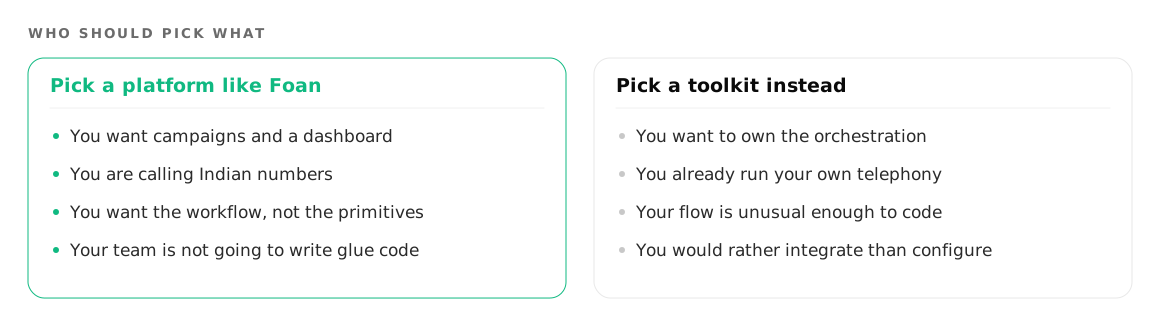
Pick Foan if your calls are mostly India-first, if buying an Indian number with KYC handled for you saves weeks, if you want to keep your business number and forward to an agent, or if you want to drive the platform from an API, a CLI or an MCP server inside your own coding agent.
Pick a platform with a visual flow builder, such as Retell's node-based flows, if your call is a branching script with compliance-critical paths that non-engineers must read and edit.
Pick Vapi if you want component-level control and itemised pass-through pricing, and your team is happy assembling the stack. Pick Bolna if you want an India-focused platform with an all-in published per-minute rate.
Where to go next
For the mechanics rather than the comparison, start with how to build an AI phone agent, then read what an AI voice call costs per minute before you budget. The telephony routes above are set out in full on the phone page.
Try it on your own number
Build an agent, point a number at it and listen to the first call.