Spam Likely is not a verdict from a central authority. It is a score, computed independently by carriers and by apps on the handset, from how a number behaves. Short calls, high volume from one number in a short window, a low answer rate and no calling history all push the score up. Change the behaviour and the label follows, slowly.
What is the Spam Likely label, actually?
When a phone shows Spam Likely, Scam Likely, Spam Risk or a red warning banner, several different systems could be responsible. The carrier may be scoring the call in its network before it ever reaches the device. The handset's own dialler may be scoring it. A caller ID app the recipient installed may be scoring it, using crowdsourced reports from its own users. Different recipients on different networks with different apps can see different labels for the same call.
Two consequences follow. There is no single registry to petition: people go looking for the list their number got onto, and there is no such list, only several scores with their own inputs and their own decay. And the label is a lagging indicator, so it does not appear the moment you do something wrong and it does not clear the moment you stop. Anything promising an instant fix is selling something.

What behaviour drives the score up?
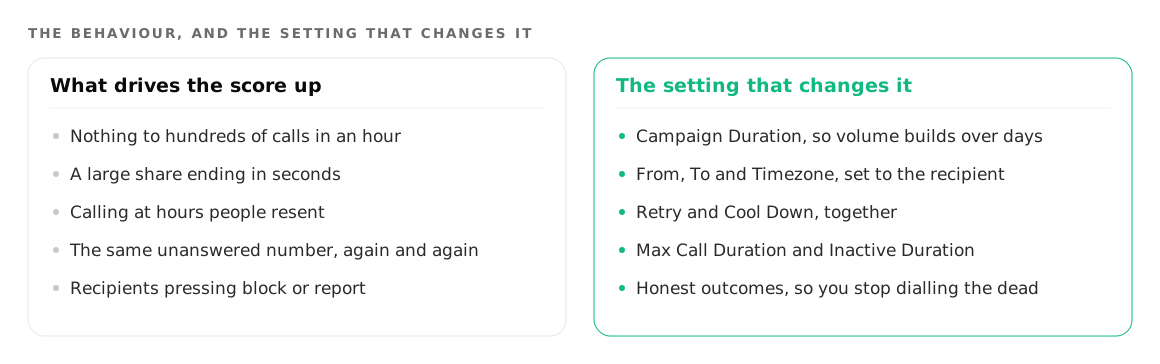
The inputs are not published, and any specific weighting you read is a guess. The behaviours below are the ones consistently associated with the label, and all of them are also signs of a badly run calling programme.
- Very short calls. A large share of calls that end within a few seconds looks like a machine dialling, because that is what it usually is.
- High volume from one number in a short window. A number that goes from nothing to hundreds of calls in an hour has no history to justify the burst.
- A low answer rate. If most of your calls are not picked up, the pattern resembles list dialling rather than a business calling people who expect to hear from it.
- Repeat calls to people who never answer. Dialling the same unanswered number again and again is one of the clearest negative signals there is.
- No history. A brand new number has nothing in its favour. It is not trusted, it is simply unknown, and unknown behaves like suspicious under a scoring system.
- Recipient reports. People pressing the block or report button in a caller ID app feed the crowdsourced side directly.
Notice what is absent from that list: whether an AI or a human is speaking. Scoring systems see call metadata and outcomes, not the contents of the conversation. An AI calling programme does not get labelled for being AI. It gets labelled for behaving like a robodialler, which is a trap worth avoiding either way.
What to do about it, mapped to real controls
Every remedy below is a behaviour change, and each has a setting in a Foan campaign that implements it. The campaign wizard has four tabs, Campaign Details, Call Settings, Data Extraction and Follow ups, and the deliverability controls sit across the first two and the last.
Warm up a new number slowly
Do not open a new number with your full list. Run a small batch to contacts most likely to pick up, let real conversations happen, and increase over days. In Foan this is a campaign design decision rather than a toggle: split the list, set the Campaign Duration across a wider start and end date, and let volume build. Nothing substitutes for a number accumulating a record of answered, reasonable length calls.
Keep calling windows civil
Calling at hours people resent is the fastest way to collect manual spam reports, which is the one input you can actively make worse.
Foan campaigns have a calling window with a From and To hour and an explicit Timezone, plus a Target Country for the country code being dialled. Set the window to hours you would be happy to receive the call yourself, and set the timezone to the recipients' timezone, not yours. The gap between those two is how respectable companies end up ringing people at night.
Cap retries and space them out
Two controls do this work. Retry sets how many times a contact is attempted, and Cool Down sets the gap between attempts. A tight retry count with a real cool down between attempts looks like a business trying to reach someone. A high retry count with no gap looks like a dialler, to the scoring systems and to the person being called.
Max Call Duration and Inactive Duration are worth setting deliberately too. Inactive Duration ends a call that has gone silent, so dead lines are not held open.
Stop calling people who do not answer
This is where honest outcome reporting earns its keep. Foan reports six user facing outcome buckets rather than lumping everything together: answered, no answer, busy, rejected, voicemail and failed. Before this change, busy lines and unanswered rings were all reported as failures, which made it impossible to tell a network problem from a person who was simply not picking up.
The distinction is the point. Mostly no answer is a list or timing problem, and dialling harder makes the score worse. Busy means the line is live and a later attempt is reasonable. Failed means something on the telephony path needs looking at, and more dialling will not help.
Foan's follow up rounds are built around the same distinction. When you turn follow ups on, you choose who gets called again from labelled buckets: did not answer, never reached, went to voicemail, hung up, asked us to call back, unclear, and interested. The default selection is the first three. You get at most five rounds after the first run, with a wait you set in days between them, which is a deliberate ceiling on how many times one person can hear from you.
Never call the people who said no
Anyone recorded as not interested, do not call, or wrong person is permanently excluded from every future round, regardless of what you tick. That is enforced in the product, not left to the operator's discipline. The campaign screen says so in plain words.
This is the single most effective deliverability control there is, because those are precisely the people who press the report button.
Use a number your audience recognises
People answer numbers that look local to them. A higher answer rate is a positive input to the score and a better campaign outcome, so the choice pays twice. Foan sets the Dialing Number per campaign, so a regional campaign can run on a number suited to its region rather than on one national number carrying every campaign's reputation.
Identify yourself in the first sentence
Say who is calling and why before anything else. A vague opener produces exactly what you do not want: the recipient hangs up almost immediately, creating a short call, which is one of the behaviours the score watches.
You control this through the agent's Greeting Message. Name the business and give the reason in one short sentence. An honest opener survives the start of a call far better than a friendly one that says nothing, which is the argument in setting up outbound campaigns.
Honour opt out immediately
When someone asks not to be called, that has to take effect on the call, not after a review cycle. In Foan the outcome codes carrying an explicit refusal trigger permanent exclusion, and it holds across follow up rounds. Where refusal is common, as in payment reminder calls, design around this first.
What about India specifically?
Indian telecom regulation governs commercial calling, and the obligations attached to a number depend on how that number was obtained, who provides it, and what kind of calls you are making. Those obligations are real and they change.
Foan does not publish an interpretation of them, because getting it wrong in either direction is worse than saying nothing. Check your obligations with your telecom provider, and get the answer in writing from whoever supplies your number. If you buy a number through Foan's India numbering partner, the compliance steps are part of that flow.
Treat the regulatory question and the spam label question as separate problems. Following the rules does not by itself stop a carrier's scoring system from flagging a number that behaves badly, and a well behaved number is not a substitute for meeting your obligations.
All of these controls live on the campaign, so create a free account and check yours against the list above before your next run. Phone agents covers the call path, and pricing is worth a look because retries against dead numbers cost money as well as reputation. If you are dialling about money specifically, payment reminder calls has the tone rules, and qualifying property leads by phone shows what honouring an outcome looks like on a real list.
What to do if a number is already flagged
Slow down first. Cut daily volume, widen the cool down between retries, tighten the calling window, and drop every contact who has not answered across several attempts. Then give it time, because scores decay on evidence of different behaviour and evidence takes calls.
If one number carries the reputation of several unrelated campaigns, separate them onto different dialling numbers so a badly targeted list is not poisoning the number your good campaigns depend on. Then ask your telecom provider what remediation paths exist on their side. That is a question they can answer about your specific number, and a blog post cannot.
Where to go next
The controls named here are covered end to end in outbound calling campaigns, and the strictest opt out discipline is in payment reminder calls. To see the outcome buckets and calling windows on a live agent, start at the voice product page.
Try it on your own number
Build an agent, point a number at it and listen to the first call.