
A payment reminder call tells someone a bill is due and gives them a way to pay it. That is the whole job. It is not a negotiation, not a warning, and not a collections script. An automated agent suits the task precisely because it will not improvise pressure under stress, and because the platform can enforce limits that no written script can enforce on its own.
The risk in this use case is never the technology. It is tone, repetition and who you talk to. This post covers what the agent should say, what it must never do, and which product control actually holds each rule in place.
Why a reminder is not a collections call
Most overdue invoices are not disputes. They are forgotten, stuck with an approver, or sitting behind an expired payment link. The person on the other end usually intends to pay. A call that opens with consequences turns a clerical problem into a confrontation, and it does that to most of the people who were never a problem.
There is a second reason to keep the two apart. A reminder is short, factual and one way, so it can be scripted tightly and audited easily. A collections conversation involves judgement and often a settlement. That is human work.
Draw the line at the design stage. The agent informs. The moment the call stops being informational, it stops being an AI call.
What should the agent actually say?
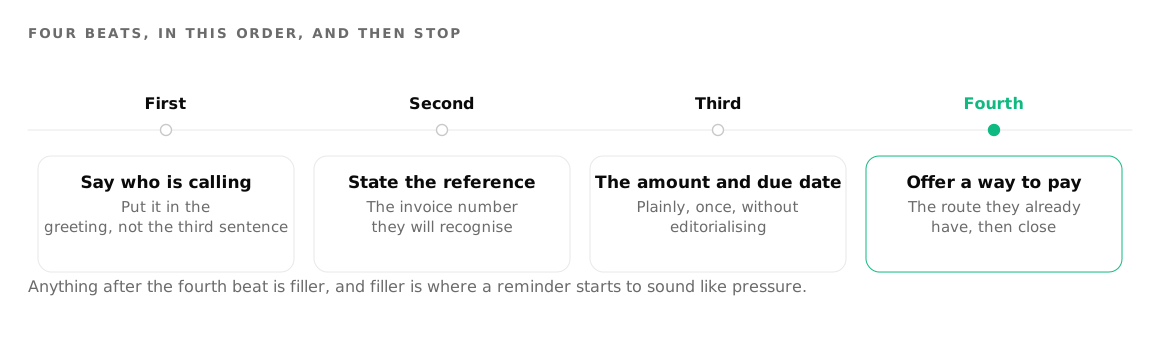
Keep the script short enough that it survives a distracted listener. Four beats, in this order.
- Identify the business in the first sentence. Not the third. The caller needs to know who this is before they decide whether to keep listening. Put this in the greeting message on the agent rather than leaving it to the model to improvise.
- State the reference. The invoice number, or the account reference, or whatever the customer will recognise on their own records. A reminder with no reference is unactionable.
- State the amount and the due date. Plainly, once. Do not editorialise about lateness.
- Offer a way to pay, then stop. Name the route the customer already has, such as the link they were sent or the portal they already use. Then close the call.
Anything after those four beats is filler, and filler is where an automated agent starts to sound like it wants something. Give the agent a closing message so the end of the call is as deliberate as the beginning.
The caller's number already reaches your systems on every tool call the agent makes, so an agent that looks up a balance never needs to ask for a phone number. Asking for details the platform already has makes a polite call feel like a probe.
What the agent must never do
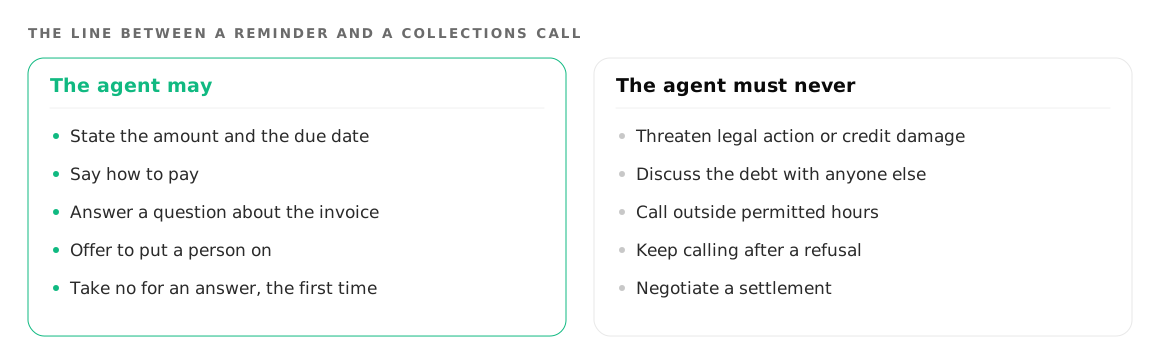
- Never apply pressure. No consequences, no urgency language, no repetition of a threat in different words. If a customer needs to hear about consequences, a person should say it.
- Never discuss the debt with anyone other than the account holder. If the voice on the line is not the right person, the agent gives the business name, asks for a callback, and ends. It does not leave the amount with a colleague, a spouse or a receptionist.
- Never call outside civil hours. This is a setting, not a matter of intent.
- Never keep calling someone who has asked you to stop. This should not depend on anyone remembering to update a list.
The last two are the ones that go wrong in practice, because both depend on a system rather than a script. Which brings us to the controls.
Each guardrail below is a real setting rather than a line in the prompt, so create a free account and check them on a draft campaign before you dial anybody. Fintech covers the wider picture, phone agents covers the call itself, and pricing matters here because a reminder that recovers an invoice has to cost less than the invoice.
Which controls enforce each guardrail?
Lead with the one that matters most, because it is the one the product takes out of your hands.
Three results are never re-dialled
When a campaign finishes and Foan builds the next round, three per-call results are permanently excluded: said no, asked not to be called, and wrong person. It does not matter which follow-up boxes you tick. The screen says so in plain words, and the rule is in the code that builds the round, not in the prompt. You cannot accidentally reinstate someone by duplicating a campaign or re-uploading a list from a report that included them.
That is the compliance story for this use case. An opt-out you have to remember is not an opt-out. This one is enforced by the product.
A calling window, in the right timezone
Campaign details carry a From hour and a To hour, with a Timezone. Set the timezone to where the contacts live, not where your operations team sits. The window applies to the first run and to every follow-up round the campaign creates afterwards, so you set civil hours once per campaign rather than once per round.
Retry, Cool Down and Max Call Duration
Three call settings decide how persistent a single round feels.
| Setting | What it controls | Why it matters here |
|---|---|---|
| Retry | How many times a contact is attempted within the round | Caps the ring-again behaviour that reads as harassment |
| Cool Down | The wait before the next attempt | Stops attempts stacking up inside one afternoon |
| Max Call Duration | The hard ceiling on a single call | Ends a call that has drifted away from a reminder |
Set Max Call Duration deliberately. A reminder call should be short. A long one is not a thorough one, it is a conversation the agent should have handed over.
Honest outcomes, so you do not chase the wrong people
Foan reports six call outcomes: answered, no answer, busy, rejected, voicemail and failed. A busy line is reported as busy and an unanswered call as no answer, rather than everything non-connecting being swept into failure. For a reminder campaign that distinction is operational, not cosmetic. Busy means try later. Rejected means something quite different, and treating the two the same is how a polite campaign becomes an unwelcome one.
Results that carry the customer's own words
Separately from the outcome, a connected call gets a result. The evidenced results are interested, callback, not interested, do not call and wrong person, and each one must carry a verbatim quote from the transcript. The agent cannot mark someone as having asked not to be called without the line where they asked. Equally, it cannot quietly drop that line to keep the contact in the pool. There are also voicemail, hung up, no answer and unclear for calls that produced no clear position.
A callback result may carry a callback time, capped at 30 days out. If someone says call me after the fifteenth, that is honoured as a time, not converted into a general permission to keep dialling.
Five rounds, and no more
A campaign can create at most five follow-up rounds after its first run. Each round is a child of the original and inherits the same agent, number and calling hours. Combined with the three excluded results, the list gets smaller every round by design. If five rounds have not reached someone, the answer is a different channel or a person, not a sixth round.
When should the call go to a person?
Any dispute. The moment a customer says the amount is wrong, the invoice was paid, the goods were never delivered, or they want to arrange something, the agent should stop reminding and start transferring.
The behaviour on a transfer is worth knowing before you design the script around it. The agent says one short connecting line, then the caller waits in a conference with hold music while your team is dialled on a second leg. Whoever picks up hears a brief spoken summary of the call so far, then joins the caller. The agent leaves at that point, so the customer is not repeating themselves to a machine that is still listening. If nobody answers, the line is busy, or the leg reaches voicemail, the caller hears an apology and the call ends rather than sitting on hold indefinitely. Handover is configured over the API rather than on a dashboard screen, so set it up when you build the agent. There is more detail in how transfers to a human work.
What about the rules where you operate?
Commercial calling is regulated, and the rules differ by country, by industry and sometimes by the kind of debt involved. Calling hours, consent, disclosure, recording and the treatment of opt-out requests are all places where jurisdictions diverge. Check your obligations with your own counsel and with your telecom provider before you dial the first list. The controls described above are the mechanism you use to implement a policy. They are not the policy.
Two practical points that sit alongside the legal ones. Caller ID and reputation affect whether a reminder is even heard, which is covered in why AI calls get marked Spam Likely in India. And the mechanics of building the list, the window and the rounds are in setting up an outbound calling campaign.
Where to go next
If you are running reminders as part of a lending, insurance or payments operation, the fintech use cases page covers the wider set of calls that sit around them. If you are about to build your first list, start with the outbound campaign setup guide and set the calling window before you set anything else.
Try it on your own number
Build an agent, point a number at it and listen to the first call.